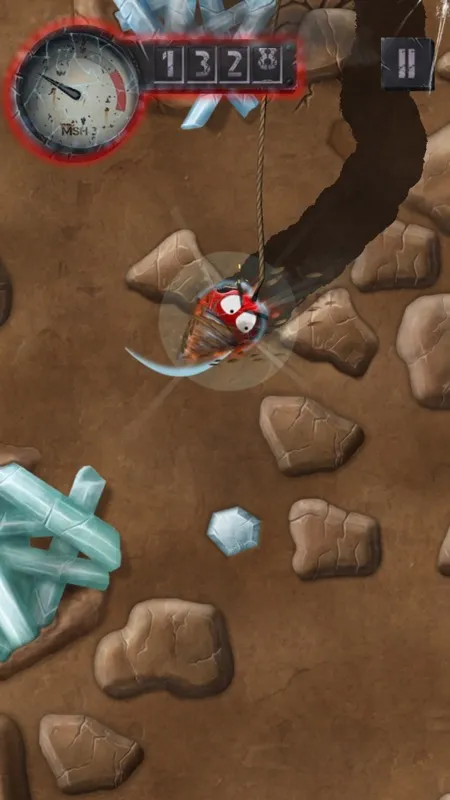
Your score in Dig Three comes from one thing: depth. Every meter you drill downward adds to your score. That sounds simple, but surviving long enough to reach serious depth is where the real challenge lies. This guide breaks down every mechanic that keeps you alive and digging.
Depth Is Everything
Crystals, checkpoints, and nitro do not directly add to your score. Your score is your depth. The only way to get a higher score is to dig deeper. Everything else in the game - crystals, nitro, upgrades - exists to help you survive long enough to keep going down.
This means the core strategy is simple: stay alive and keep digging. Every second you spend not moving downward is depth you are not gaining.
Crystal Pathing: The Core Skill
Digging damages your drill. The further you dig, the more damaged you get. Crystals are the primary way to heal. The fundamental skill in Dig Three is choosing the shortest path to the next cluster of crystals so you heal before your damage becomes fatal.
Good pathing means looking ahead. When you see crystals below and to the right, start drifting right early. Smooth curves collect more crystals than sharp last-second corrections. A gentle S-curve through crystal clusters is the hallmark of a high-scoring run.
Avoid chasing isolated crystals that require large detours. A single crystal far off to the side costs you positioning and may steer you into rocks. Groups of crystals along your natural path are always more valuable than lone ones far away.
Nitro: Speed, Healing, and Rock Breaking
Nitro is your most powerful tool. When active, it does three things: you move faster, you heal, and you break through rocks that would otherwise block or damage you. What nitro does not do is give you bonus points. Your score still comes purely from depth.
The best time to use nitro is when you see a dense section of rocks ahead. Blasting through a rock formation that would have forced a slow detour saves you health and gains depth quickly. The worst time to use nitro is in an open section with plenty of crystals - you do not need it there, and it is better saved for when things get rough.
Special gems - gold and rubies - give you a quick nitro boost when collected. Keep an eye out for them, especially when your nitro gauge is low and rocks are closing in.
Rock Avoidance
Rocks are the main obstacle. Hitting a rock does massive damage and stops your momentum. Learning to read rock formations is crucial for reaching deeper levels.
Common patterns include the zigzag (alternating left-right rocks), the funnel (rocks narrowing to a small gap), and the wall (a solid line with one opening). When you see a wall approaching, commit to a gap early. Hesitating between two possible openings is the most common way to end a run.
If you cannot avoid a rock, use nitro. A nitro-powered collision breaks the rock instead of damaging you. This is often better than a risky dodge that might send you into an even worse position.
The Upgrade Loop
At checkpoints, you meet your stranded crewmates. They give you parts: hull (reduces digging damage), drill (faster turning), and engine (more speed). These upgrades are permanent and make every subsequent run easier.
From any checkpoint, you can teleport back to the surface to visit the shop and spend resources on upgrades, then teleport back down to continue from where you left off. Use this. Upgrading your hull early means you take less damage per meter of digging, which means you need fewer crystals, which means you can take more direct paths downward.
For score-pushing runs, prioritize hull upgrades first. Less damage means longer survival, which means more depth. Engine upgrades help you reach depth faster but do not directly help survival. Drill upgrades help with precise crystal pathing.
Advanced: Reading the Earth
The deeper you go, the more the environment hints at what is coming. Crystal density increases near checkpoints. Rock formations get tighter and more complex. The earth color shifts as you approach different biomes.
Top players learn to predict crystal clusters by watching the rock patterns. Crystals tend to appear in the gaps between rock formations. If you see a tight cluster of rocks ahead, there are usually crystals waiting in the clear space just after it. Plan your path to pass through the rocks and into the healing zone beyond.
Putting It All Together
A top-scoring run looks like this: start digging with smooth S-curves through crystal clusters. When rocks appear, either navigate through the gaps or activate nitro to blast through. At checkpoints, grab upgrades and teleport to the shop if you have resources to spend. The deeper sections are harder, but your upgraded hull, drill, and engine make you tougher too. Keep healing, keep dodging, keep going down.
Ready to set a new record?
Put these techniques into practice. Dig Three is available on the App Store.